
Paper is still a leading cause of data breaches
Physical documents remain one of the largest sources of reported data breaches, often well ahead of hacking. Official figures from regulators in the US and Europe tell the same story:
- United States: 60% of the 74,299 smaller healthcare breaches (affecting fewer than 500 people) reported to the US Department of Health and Human Services in 2024 involved paper records.
- United Kingdom: organizations reported 1,361 paper-related breaches to the Information Commissioner's Office in 2025, nearly four every day. The number has barely changed since 2021.
- Netherlands: 41% of breach notifications in the first half of 2024 involved a letter or parcel containing personal data, five times the share caused by hacking, malware and phishing.
- Ireland: half of the 6,521 breach notifications made to the Data Protection Commission in 2025 arose from correspondence sent to the wrong recipient.
Many of these documents begin life at a printer. The printers themselves are exposed too: Ringdale's Global Imaging & Printing Threat Landscape 2026 counted 13,547 printers reachable from the public internet.
Most organizations rigorously manage network security, encryption and access controls. Printers, multifunction devices and scanners often sit outside that discipline, even though they process some of the most sensitive documents a business produces: contracts, payroll, patient records and financial statements.
Secure print management software such as FollowMe closes that gap. It brings print under the same identity, policy and audit controls as the rest of the IT estate, and helps organizations demonstrate compliance with frameworks including ISO/IEC 27001, GDPR, NIS2, HIPAA and the Sarbanes-Oxley Act.
Why print is an open gateway
The print environment combines four risks that rarely get the attention they deserve.
- Unattended output. Documents left in output trays on shared printers are the simplest breach of all. Anyone walking past can read or take them.
- Mixed, aging fleets. Many organizations run devices from several manufacturers, each with different security settings and firmware. Ringdale's Threat Landscape 2026 found that many organizations still run printers that no longer receive firmware updates, and that some device flaws cannot be fixed in firmware at all.
- Devices as network endpoints. Modern multifunction devices have hard drives, operating systems, network services and firmware that can be exploited. Regulators now recognize this: the EU Cyber Resilience Act applies to hardware and software products that connect to a device or network, which brings networked printers and multifunction devices into scope.
- Hybrid and remote work. Printing now happens across offices, branch sites and homes, often outside the reach of central controls.
FollowMe addresses these risks with a single, vendor-neutral policy layer across the whole fleet. Jobs are held securely until the user authenticates at the device, and devices cannot be used until the user signs in. The result is that documents are released only to the right person, wherever and whenever they choose to print.
Aligning print with the CIA triad
Proactive print management supports all three principles of information security: confidentiality, integrity and availability.
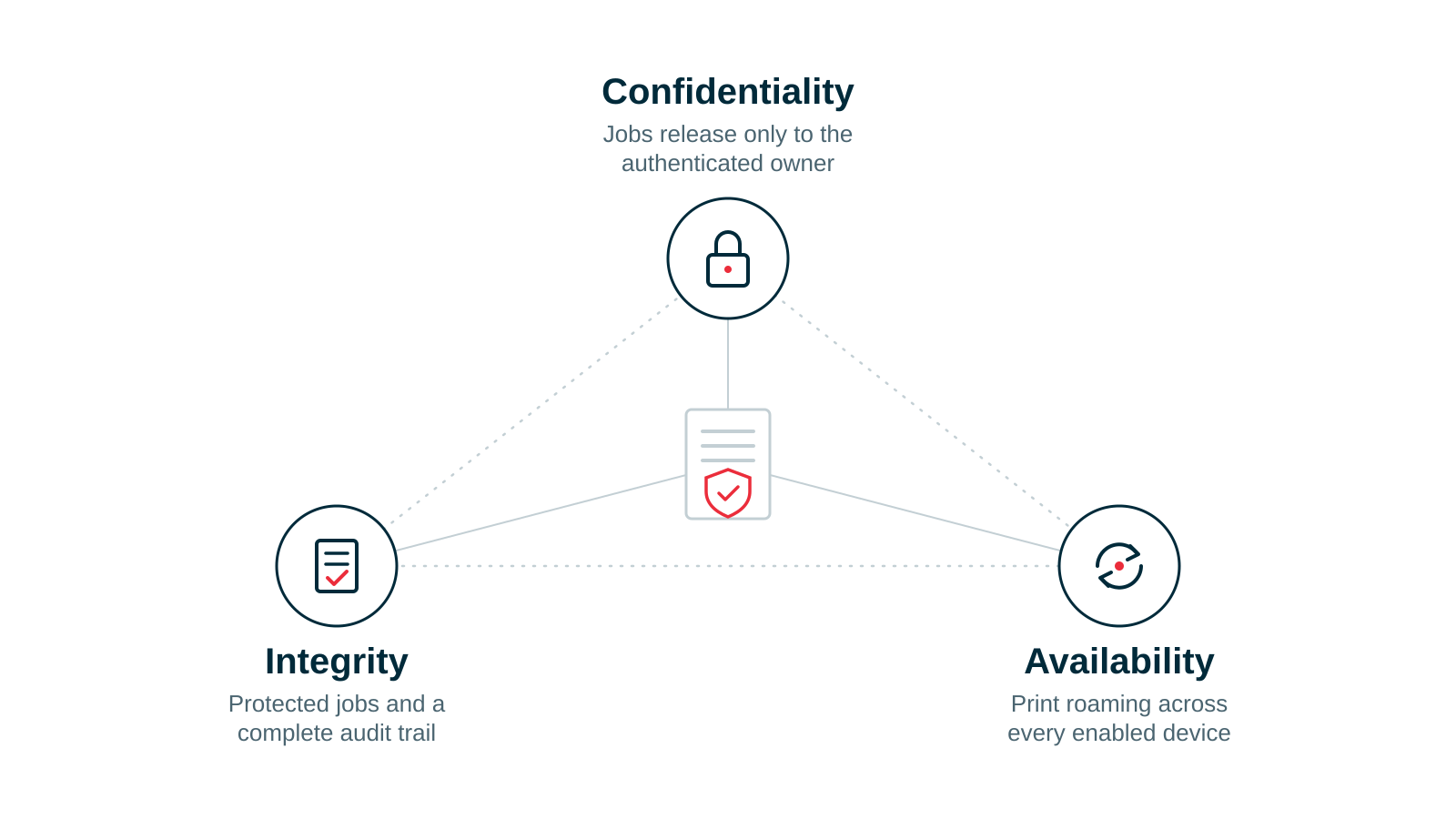
- Confidentiality. Sensitive information should reach authorized people only. FollowMe holds every job until the owner authenticates at the device, with a badge, PIN or single sign-on, so confidential documents are never left waiting in an output tray.
- Integrity. Information should stay accurate and complete. FollowMe protects print jobs in transit and at rest, and keeps a detailed audit log of who printed, copied or scanned what, where and when.
- Availability. Information and services should be there when authorized users need them. Print roaming lets users collect jobs at any enabled device, so a single printer fault does not stop work, and central queue management keeps printing running smoothly.
Meeting today's regulatory requirements
No product makes an organization compliant on its own, but secure print management supplies the controls and the evidence that auditors look for.
| Framework | Who it applies to | How FollowMe supports it |
| ISO/IEC 27001:2022 | Any organization running an information security management system | Supports Annex A controls for access control, clear desk, media handling, and logging and monitoring |
| GDPR and UK GDPR | Organizations processing personal data of individuals in the EU or UK | Pull printing prevents accidental disclosure; audit logs support accountability and breach investigation |
| NIS2 Directive | Essential and important entities in 18 sectors across the EU | Supports risk management, access control and incident detection duties, which now carry personal accountability for management |
| DORA | EU banks, insurers, investment firms and their ICT providers | Supports ICT risk management and operational resilience across the print estate |
| HIPAA | US healthcare providers, health plans and their business associates | Secures printed protected health information and logs access to it |
| Sarbanes-Oxley Act | US-listed public companies | Audit trails support internal controls over the handling of financial documents |
| PCI DSS v4.0.1 | Any organization that stores, processes or transmits payment card data | Supports physical security of printed cardholder data and access logging |
The landscape continues to tighten. The UK Data (Use and Access) Act 2025 brought major amendments to UK GDPR into force in 2026. Most EU member states have now transposed NIS2, and regulators are moving from guidance to enforcement. In the US, HHS has proposed the first major overhaul of the HIPAA Security Rule in over a decade, including mandatory multi-factor authentication, with final action now expected no earlier than July 2027. Organizations that put strong print controls in place now will be ready whichever way the final rules land.
Identity, audit trails and monitoring
Identity is now the foundation of print security. Print management systems connect to the corporate directory, email and file shares, which makes them part of an organization's identity infrastructure. Ringdale's Threat Landscape 2026 found that all three print-related additions to the US government's catalog of actively exploited vulnerabilities in the past year concerned print management software. The platform itself must therefore be secured as carefully as any identity system: independently certified, patched promptly and backed by a clear security advisory process.
FollowMe ties every print, copy and scan to an authenticated user. That record matters in three ways:
- Detection. Usage reports make unusual activity, such as large volumes printed out of hours, easy to spot.
- Investigation. When an incident occurs, the audit trail shows exactly who handled which document, on which device and when. This supports breach notification duties under GDPR, NIS2 and HIPAA.
- Evidence. Auditors can see that print controls exist and operate as intended.
The same data also shows how the fleet is used, helping organizations right-size their devices, reduce waste and lower costs.
Five steps to a secure print environment
- Assess the fleet. Identify every device, its firmware level and who can use it. Retire or isolate devices that can no longer be patched.
- Require authentication at every device. Hold all jobs until the user signs in, ideally with the same identity they use for email and other business systems.
- Apply one policy across all brands. Use vendor-neutral software so that security does not depend on which manufacturer made the printer.
- Log every print, copy and scan. Keep audit trails for as long as your regulatory obligations require, and review them regularly.
- Include print in your security program. Cover printers and print servers in risk assessments, patching, incident response plans and supplier reviews, just like any other endpoint.
Closing the print security gap
Print is no longer a blind spot that organizations can afford. Physical documents remain one of the leading causes of reported data breaches, attackers are paying closer attention to print infrastructure, and regulators across the US, UK and EU expect every endpoint to be secured and accounted for.
FollowMe gives organizations one secure, vendor-neutral platform to authenticate users, protect documents and record every action across the entire fleet. It strengthens security today and provides the evidence needed to meet the regulations of tomorrow.
How secure is your print environment? Schedule a call with our team to discuss your print security and compliance priorities.
Key sources: US Department of Health and Human Services, Annual Report to Congress on Breaches of Unsecured Protected Health Information, 2024; Information Commissioner's Office, Data security incident trends; Ringdale, Global Imaging & Printing Threat Landscape 2026.